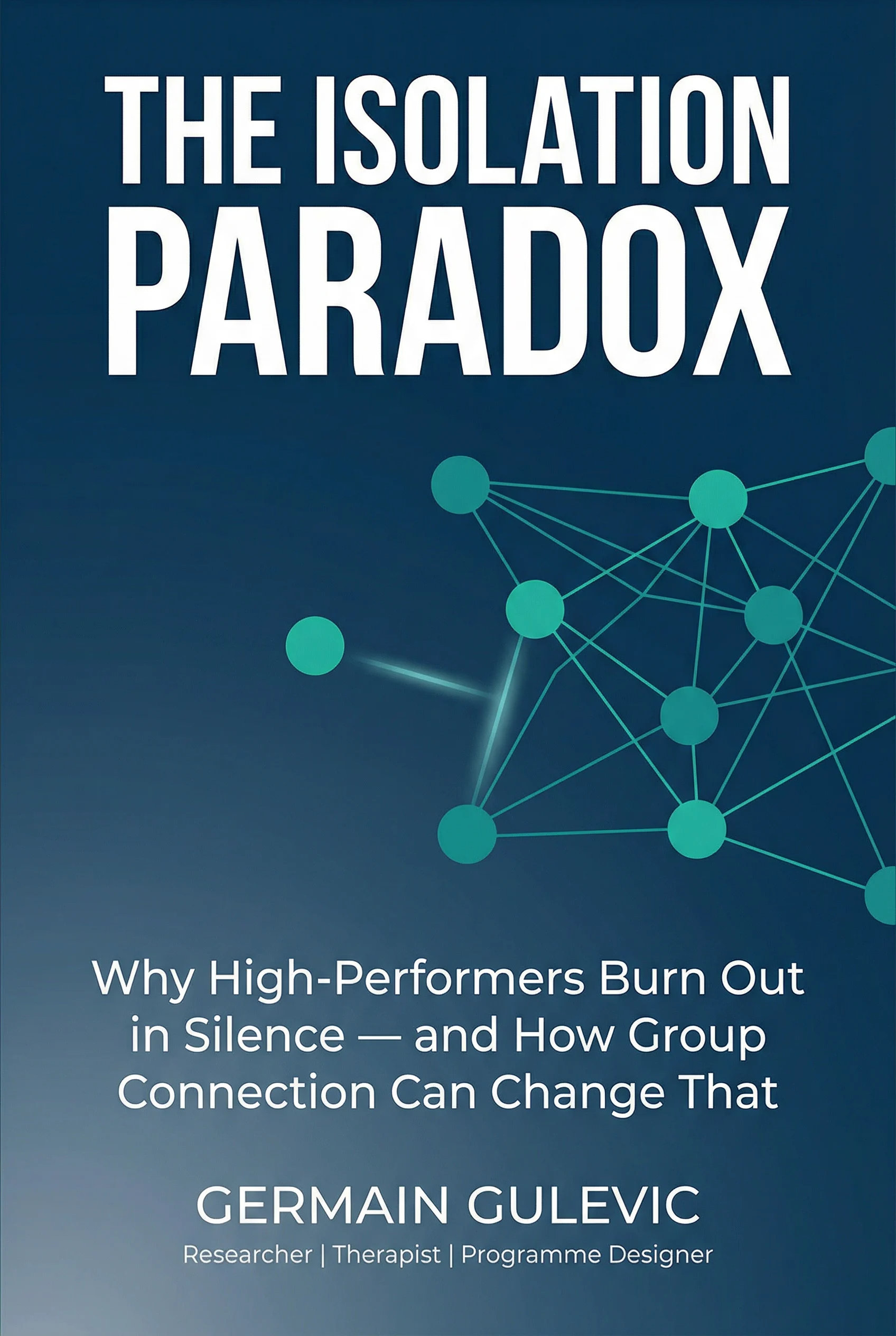
The Isolation Paradox
Why High-Performers Burn Out in Silence — and How Group Connection Can Change That
By Germain Gulevic — Researcher | Therapist | Programme Designer
The Scale of the Crisis
of UK work-related ill-health is occupational stress
working days lost every year to stress
annual cost to the UK economy (£)
of FTSE 100 firms call mental health mission-critical
The Problem Nobody Talks About
You're Not Burning Out Because You're Weak.
You're Burning Out Because You're Isolated.
Up to 98% of managers report moderate to severe stress. Among junior lawyers, 93.5% experienced stress in the past month. Police officers: 82%. Social workers: 80%. Teachers: 75%+.
“She hasn't told a single person at work that she hasn't slept properly in four months, that she cries in her car before she goes in most mornings, or that she's started to feel nothing where she used to feel purpose. She's not weak. She's isolated. And the isolation is structural, not personal.”
— From The Isolation Paradox, Chapter 1
Original Research Findings
Three Paradoxes That Change Everything
The Isolation–Connection Paradox
The more isolated a professional feels, the more they want group-based support — yet they are the least likely to seek it. Experience deepens the desire for connection, not the ability to access it.
The Employer–Support Paradox
69.4% of professionals want support delivered independently of their employer. Only 19.4% expect workplace backing. Seniority amplifies this: the more experienced you are, the more you want autonomy.
The Willingness-to-Pay Paradox
Cost is the #1 barrier (62.5%), yet nearly half of professionals would invest £300–£599 in a programme that genuinely works. They're not price-sensitive — they're value-sensitive.
Inside the Book
From Evidence to Action — In Three Phases
Not a self-help book dressed in clinical language. Not generic wellness advice. A research-grounded guide that closes the gap between what works and what's currently available.
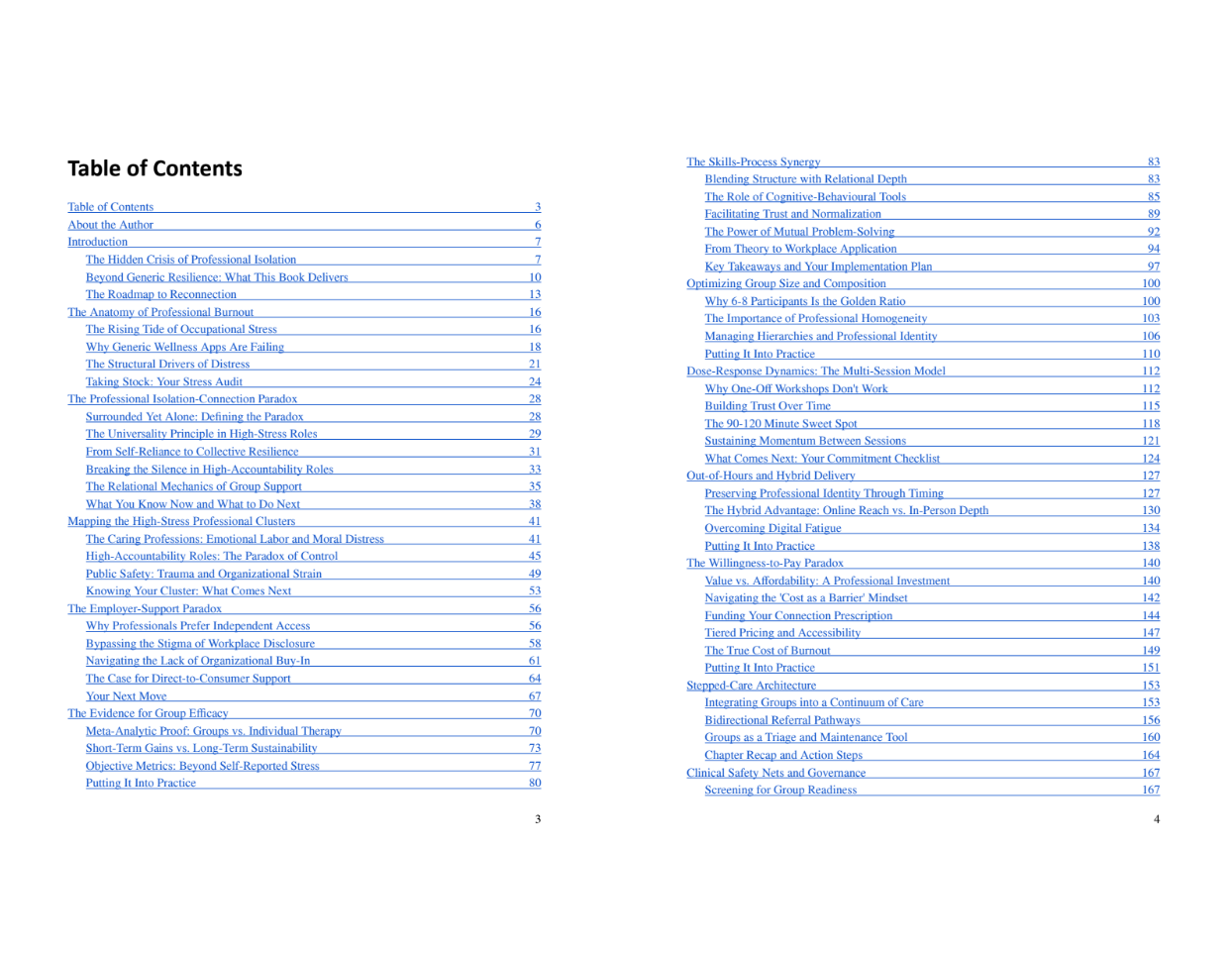
Understanding the Crisis
- The anatomy of professional burnout across 6 sectors
- Why generic wellness apps are failing
- The Professional Isolation–Connection Paradox
- Three distinct high-stress professional clusters
- Why self-reliance isn't resilience
What Actually Works
- Meta-analytic evidence for group efficacy
- The Skills–Process Synergy model
- Optimal group size, composition & dose-response
- Out-of-hours and hybrid delivery design
- Why one-off workshops don't work
Building Sustainable Services
- Clinical safety nets and governance
- Stepped-care architecture integration
- Direct-to-consumer positioning strategy
- The phased implementation roadmap
- Pricing models and financial sustainability
Comprehensive Coverage
200+ Pages of Evidence-Based Guidance
Every claim grounded in evidence. Every recommendation specific enough to act on. Where the evidence has limits, we say so clearly.
Two Audiences, One Evidence Base
Written for People Who Need Answers, Not Platitudes
For Professionals Under Pressure
- Understand why you feel the way you do — backed by evidence, not opinion
- Discover the structural drivers behind your stress — it's not a personal failing
- Learn what evidence-based support actually looks like and how to find it
- Take your own Stress Audit with research-normed benchmarks
- Make informed decisions about your recovery — independently, on your terms
Sectors Covered
Healthcare · Education · Legal · Management · Social Work · Public Safety
For Practitioners & Service Designers
- Evidence-based architecture for group intervention programmes
- Screening, governance, and clinical safety frameworks
- Facilitator competency models and quality assurance systems
- Financial sustainability: pricing, positioning, and direct-to-consumer strategy
- A phased implementation roadmap from pilot to permanent service
Relevant For
Therapists · Coaches · L&D Professionals · HR Consultants · Wellbeing Services
What 72 Professionals Revealed
The Data That Challenges Assumptions
79.2%
express willingness to engage with evidence-based group support
2.4:1
practical-to-psychological barrier ratio — logistics, not stigma, is the obstacle
69.4%
want support delivered independently of their employer
76%
rated CBT stress management skills as highly valuable content
53.4%
prefer multi-session series over single workshops
£350–450
average willingness to invest in a programme that genuinely works
About the Author
Germain Gulevic
Germain Gulevic is a researcher, therapist, and programme designer whose work focuses on occupational stress, professional isolation, and evidence-based group interventions for high-stress professionals.
His mixed-methods research project — integrating survey data from 72 high-stress professionals with clinical insights from five experienced therapists across six sectors — identified the Professional Isolation–Connection Paradox and the Employer–Support Paradox as defining features of this population's experience.
Through books, digital resources, and programme materials, Germain translates rigorous research into practical, accessible tools for both professionals experiencing stress and the practitioners who support them.
This Book Is Different. Here's Why.
Original Empirical Research
Not a rehash of existing frameworks. Built on a dedicated study with real professionals and real therapists.
Dual-Audience Design
Written simultaneously for professionals seeking support and practitioners designing services.
Actionable at Every Chapter
Every chapter ends with specific next steps. No "food for thought" without a recipe.
Honest About Limitations
Where the evidence has limits, we say so. Where claims are made, they're grounded in data.
The Gap Between What Works and What's Available Is Vast.
This Book Closes It.
200+ pages of evidence-based guidance for professionals and practitioners. Grounded in original research. Written to be acted on.
Available as eBook (PDF, Kindle, ePub). Instant download from gulevic.com/shop